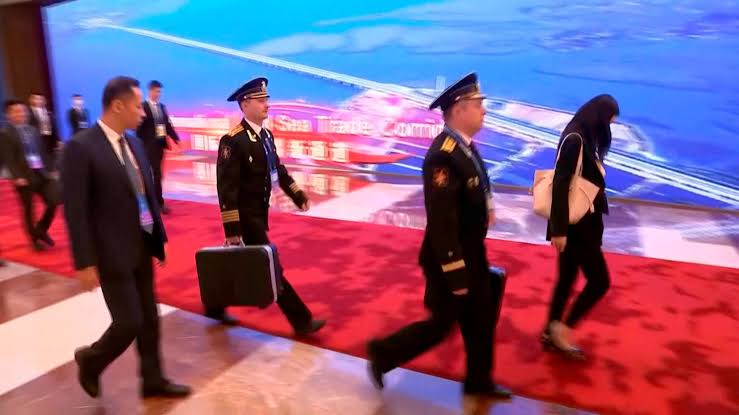
Russian President Vladimir Putin's delegation has attracted international attention at the 2026 Asia-Pacific Economic Cooperation (APEC) summit in Shenzhen after footage showed one of his aides carrying a briefcase identified as part of Russia's strategic nuclear command system.
The briefcase, known as the Cheget, was reportedly seen accompanying Putin during his visit to China, where he is attending the APEC summit scheduled for November 18 and 19.
Russian state television journalist Evgeny Popov drew attention to the device in a video showing him approaching one of Putin's aides and asking whether the briefcase was the country's nuclear command case.
When Popov asked whether it was indeed the nuclear briefcase, the aide reportedly responded: "Yes, that's the one."
The exchange has generated interest because the Cheget is associated with one of the world's most closely guarded military command systems.
What is Russia's Cheget nuclear briefcase?
The Cheget is a portable communications terminal forming part of Russia's Kazbek strategic nuclear command and control system.
It is designed to provide Russia's top leadership with secure communication capabilities for matters involving the country's nuclear forces.
The system allows senior officials to communicate and transmit authorised commands through the established military command structure.
Russia's president serves as the country's supreme commander-in-chief and holds the highest political authority over decisions involving nuclear weapons.
The Cheget is therefore an important component of the country's nuclear command arrangements, although it is not simply a briefcase containing a button that independently launches nuclear missiles.
Why Putin travels with the nuclear briefcase
The presence of the Cheget during Putin's foreign visits is widely regarded as part of Russia's standard presidential security and military communication arrangements.
The device ensures that the Russian president can maintain access to secure nuclear command communications while travelling outside the country.
Russia's nuclear command system is designed to maintain communication between the country's senior political and military leadership, including during periods of international tension.
The briefcase is rarely shown in detail to the public, making footage of an aide openly confirming its identity particularly noteworthy.
Similar footage emerged in October 2023 when Russian naval officers accompanying Putin during his visit to China were filmed carrying briefcases associated with the nuclear command system.
Putin's presence at the Shenzhen APEC summit
Putin arrived in Shenzhen on November 18, 2026, to participate in the 33rd APEC Economic Leaders' Meeting.
Chinese President Xi Jinping's chief of staff, Cai Qi, received the Russian leader at Shenzhen Bao'an International Airport in a high-level diplomatic welcome.
Putin subsequently held discussions with Xi, with the two leaders addressing bilateral relations, economic cooperation, energy, technology and international developments.
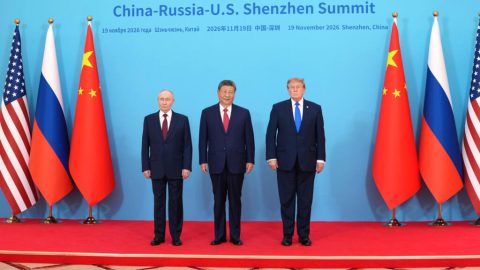
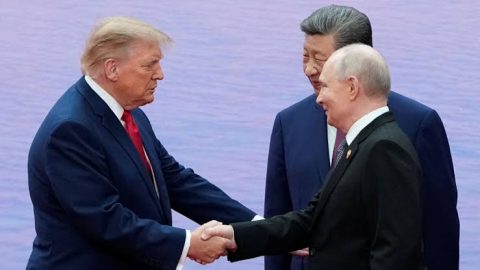
The summit has also attracted attention because of plans for a historic meeting involving Putin, US President Donald Trump and Xi Jinping on November 19.
The proposed trilateral engagement is expected to provide an opportunity for discussions on international security, geopolitical tensions and relations among the three major powers.
A security symbol amid global tensions
The appearance of the Cheget comes at a time when international relations remain strained by conflicts, military competition and disagreements among major powers.
Russia's nuclear arsenal remains one of the largest in the world, making its command and control arrangements an important subject of international security discussions.
However, the presence of the briefcase at the APEC summit does not, by itself, indicate that Russia is preparing to use nuclear weapons or that its military alert status has changed.
Rather, the footage highlights the security arrangements maintained around the Russian president and the importance Moscow attaches to preserving access to its strategic command system during overseas engagements.
As world leaders gather in Shenzhen, attention remains focused on whether the high-profile diplomatic meetings will produce progress on international security, trade and relations among the world's leading powers.

Comments (0)
No comments yet.
Only registered readers can comment.
Sign in or create a free account to join the discussion.