A social media video comparing the prices of selected staple foods in Ghana in late 2024 with more recent market prices has triggered fresh political debate over the cost of living, just days after Finance Minister Dr Cassiel Ato Forson presented the 2027 Budget.
The clip, shared by NDC communicator Abdulai Sakra Alhassan, has attracted attention from supporters of President John Dramani Mahama's administration, who see the price comparisons as evidence of economic improvement.
However, the discussion has also drawn criticism from opposition voices questioning whether the government's latest economic proposals offer sufficiently new solutions to Ghana's longstanding economic challenges.
The debate has placed household purchasing power, food affordability, public debt and the government's proposed investment programme at the centre of conversations surrounding the new budget.
Video comparison puts staple food prices in the spotlight
The video reportedly compares the prices of selected food commodities in the final months of 2024 with their more recent prices, presenting the differences as an indication of changing market conditions.
Supporters of the administration have used the comparison to argue that economic conditions have improved since the change of government, particularly in relation to the prices of essential household items.
For many Ghanaian households, food prices remain one of the most immediate measures of economic conditions. Changes in the cost of rice, maize, cooking oil, vegetables and other staples can directly affect how families manage their monthly budgets.
Nevertheless, individual market-price comparisons need to be considered alongside the location, market, quantity and period covered. A price recorded in one market may not represent the experience of consumers across the entire country.
Official figures show easing food inflation
Recent economic indicators provide additional context for the discussion.
According to the Bank of Ghana's November 2026 Summary of Economic and Financial Data, Ghana's year-on-year food inflation declined to 2.8 per cent in October 2026, compared with 4.0 per cent in September and 9.5 per cent in October 2025.
The figures indicate that food prices were increasing at a considerably slower rate than they were a year earlier.
Some commodities have also recorded actual price reductions. Data published by StatsGH on November 19, citing official consumer price figures, showed that maize was 27.2 per cent cheaper nationally in October 2026 than in October 2025. Locally grown rice was also reported to be 14.3 per cent cheaper over the same period.
These figures point to improvements in selected areas of the food market, although they do not establish that every staple has become cheaper or that all households are experiencing the same level of relief.
A reduction in inflation is also different from a reduction in the overall price level. When inflation falls, prices generally continue rising, but at a slower pace. Consumers only experience lower prices when particular goods actually become cheaper.
What the 2027 Budget promises
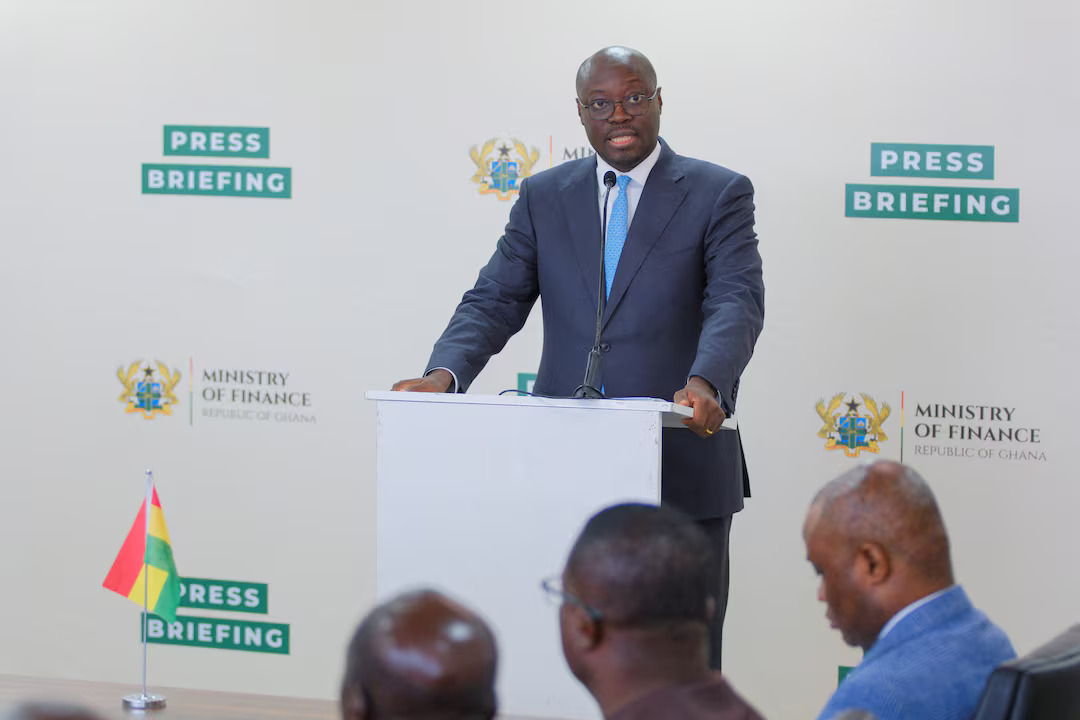
The price debate emerged shortly after Dr Ato Forson presented the 2027 Budget Statement and Economic Policy to Parliament on November 12.
The government is projecting total expenditure of GH¢389.2 billion for the 2027 financial year, equivalent to 21.6 per cent of Gross Domestic Product.
Total revenue and grants are projected at GH¢323.4 billion, while the government has announced that the budget will introduce no new taxes.
A major component is the New Economy programme, which forms part of a proposed US$10 billion investment plan covering 2027 to 2030.
The government has allocated GH¢30 billion for the programme's first year, with priorities including:
Commercial agriculture and increased domestic food production.
Energy infrastructure and reliable electricity supply.
Technology and digital transformation.
Processing and adding value to Ghana's natural resources.
Tourism, culture and the creative arts.
Textiles, garments, pharmaceuticals and biomanufacturing.
The administration says the programme is intended to strengthen domestic production, expand industrial capacity, create employment and reduce Ghana's dependence on imported goods.
Agriculture is expected to receive significant attention, with the government seeking to improve food production and processing while creating opportunities across the agricultural value chain.
Opposition questions the government's economic direction
Despite the government's emphasis on economic transformation, opposition figures have raised questions about the substance and implementation of the proposed programme.
National Petroleum Authority Chief Executive Godwin Edudzi Tamakloe has questioned the novelty of the government's economic plans, according to the political debate surrounding the budget.
The criticism reflects a wider concern about whether the new investment programme represents a sufficiently different approach or a continuation of existing policy priorities under a new framework.
Questions about public debt have also featured prominently in the discussion.
Figures presented alongside the 2027 Budget show that Ghana's provisional public debt stood at GH¢759.3 billion at the end of October 2026, representing 47.5 per cent of GDP.
The debt figure remains an important part of the debate because the government must balance its plans for infrastructure, industrial development and job creation against the cost of servicing existing obligations.
The 2027 Budget provides GH¢61 billion for interest payments, comprising GH¢51.5 billion for domestic obligations and GH¢9.5 billion for external debt.
The economic divide goes beyond political arguments
The competing reactions highlight the different ways Ghanaians assess economic progress.
For some consumers, lower prices for selected food items and slower inflation represent meaningful relief after a period of severe price increases.
For others, the more important questions concern whether incomes are improving, employment opportunities are expanding and the overall cost of living is becoming manageable.
The distinction matters because lower inflation does not necessarily reverse the increases households experienced during previous years. Even when prices stop rising rapidly, consumers may still be paying considerably more than they did before the economic difficulties.
Farmers, traders, manufacturers and households also experience price movements differently. Lower prices can benefit consumers but may create challenges for producers if their selling prices fall faster than their production costs.
Implementation will determine the impact of the 2027 Budget
As the Mahama administration advances its New Economy programme, attention is likely to shift from budget





Comments (0)
No comments yet.
Only registered readers can comment.
Sign in or create a free account to join the discussion.