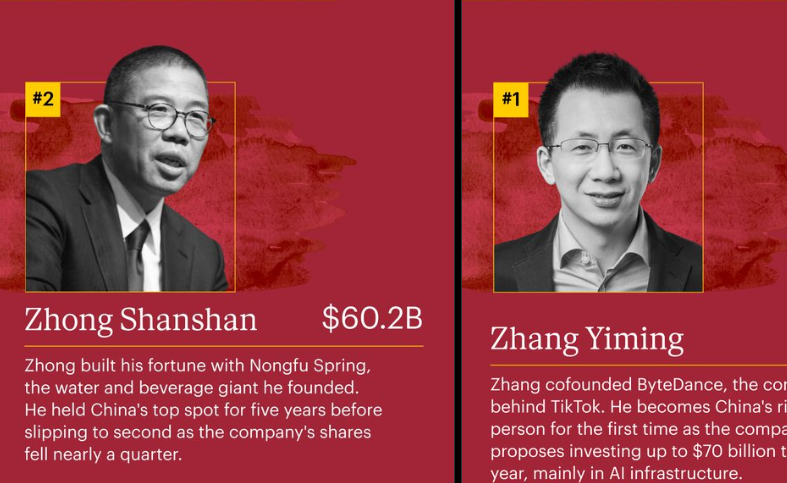
China’s billionaire rankings have undergone a major shake-up, ending Nongfu Spring founder Zhong Shanshan’s five-year reign as the country’s richest person, according to Forbes’ 2026 list of China’s 100 Richest.
ByteDance co-founder Zhang Yiming has claimed the top position for the first time, with an estimated fortune of US$84 billion, following a US$14.7 billion increase in his wealth.
The latest ranking, published on November 4, 2026, shows that the combined wealth of the 100 richest individuals in China declined by 3.7 per cent, from US$1.35 trillion in 2025 to approximately US$1.3 trillion.
Forbes attributed the decline partly to weak domestic consumption, continued difficulties in China's property sector and a 7 per cent contraction in the benchmark CSI 300 stock index over the period used to measure the fortunes.
More than half of the billionaires on the list experienced a decline in their estimated wealth, although entrepreneurs in artificial intelligence, technology and other expanding industries recorded significant gains.
Zhang Yiming Takes the Top Spot
Zhang Yiming, whose company ByteDance owns TikTok, moved to first place after increasing his estimated fortune to US$84 billion.
His rise reflects the growing influence of technology and artificial intelligence in China's business landscape. ByteDance has been expanding its AI ambitions, with a proposed investment of up to US$70 billion this year, primarily in artificial intelligence infrastructure, according to Forbes.
Zhang's achievement ends Zhong Shanshan's five-year run at the top of the ranking.
Zhong Shanshan Drops to Second Place
Zhong Shanshan, founder of bottled-water and beverage company Nongfu Spring, fell to second position after his estimated wealth declined by US$16.9 billion to US$60.2 billion.
Forbes linked the reduction to a nearly 25 per cent fall in Nongfu Spring's shares over the previous year, amid slowing revenue growth and increasing competition in China's beverage market.
Despite the decline, Zhong remains one of the country's wealthiest business figures.
DeepSeek Founder Liang Wenfeng Makes a Major Leap
One of the biggest stories in this year's ranking is the rise of Liang Wenfeng, founder of artificial intelligence company DeepSeek.
Liang climbed 31 positions to secure third place, with an estimated fortune of US$46 billion, representing an increase of US$34.5 billion.
Forbes identified him as the biggest wealth gainer in dollar terms on the 2026 list. His rise followed an October funding round that valued DeepSeek at more than US$75 billion.
His position reflects the growing financial significance of China's artificial intelligence industry and the global attention surrounding its technology companies.
China's Five Richest Billionaires in 2026
According to Forbes, the five wealthiest individuals on the 2026 ranking are:
Zhang Yiming – US$84 billion (ByteDance)
Zhong Shanshan – US$60.2 billion (Nongfu Spring)
Liang Wenfeng – US$46 billion (DeepSeek)
Robin Zeng – US$45.8 billion (CATL)
Ma Huateng – US$45.3 billion (Tencent)
Robin Zeng, chairman of battery manufacturer CATL, placed fourth despite a US$7.7 billion decline in his estimated fortune.
Tencent chairman Ma Huateng completed the top five, with his wealth falling from US$62.8 billion in the previous ranking to US$45.3 billion.
Artificial Intelligence and Robotics Reshape China's Wealth Rankings
Forbes also highlighted the growing presence of entrepreneurs in artificial intelligence, robotics and semiconductor manufacturing.
All seven newcomers to the 2026 list came from AI, robotics or related industries. Among them was Zhu Yiming, co-founder of semiconductor manufacturer CXMT, whose estimated fortune reached US$13 billion.
Wang Xingxing, founder of humanoid robotics company Unitree, also made the list as its youngest newcomer at 36.
Another notable gainer was Chen Jianhua, chairman of Hengli Group, whose fortune more than doubled to US$25.2 billion, placing him at number 10.
The changes illustrate how developments in technology, industrial manufacturing and artificial intelligence are influencing the distribution of wealth among China's leading entrepreneurs.
Why China's Billionaire Wealth Declined
Despite gains among technology entrepreneurs, the broader Chinese economy presented challenges for many of the country's wealthiest business figures.
Weak consumer spending and a sluggish property market continued to weigh on businesses, while movements in stock prices affected the estimated value of major shareholdings.
The Forbes ranking also demonstrates how quickly billionaire fortunes can change as market valuations, company performance and investment conditions shift.
With Zhang Yiming now at the top and Liang Wenfeng making a significant leap, China's 2026 rich list highlights the increasing role of technology and AI in shaping the country's billionaire landscape.




Comments (0)
No comments yet.
Only registered readers can comment.
Sign in or create a free account to join the discussion.