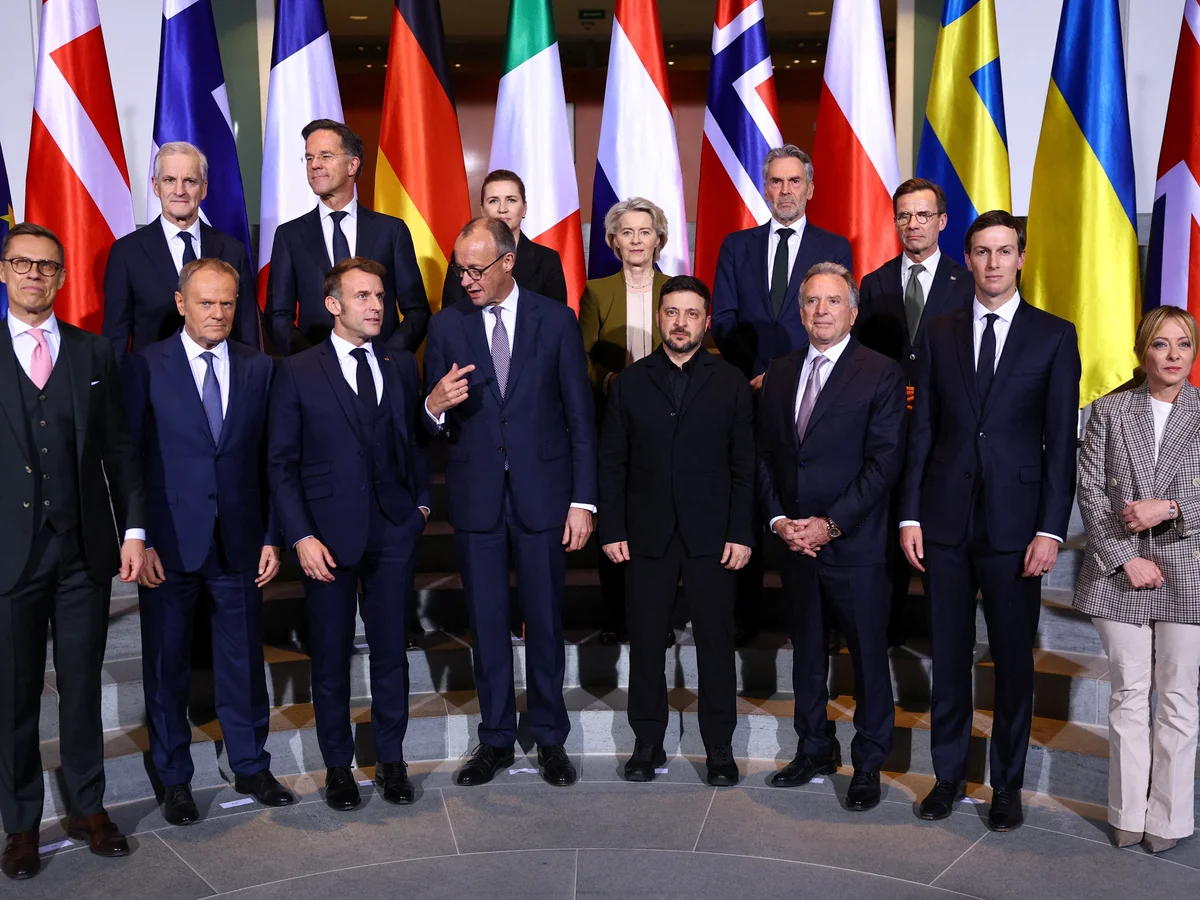
European leaders have reaffirmed their support for Ukraine at a high-level summit in Berlin, while Russian President Vladimir Putin has invited European representatives to Moscow to discuss their possible participation in efforts to end the war.
The diplomatic developments unfolded on Thursday, November 19, 2026, following a trilateral meeting involving Putin, US President Donald Trump and Chinese President Xi Jinping in Shenzhen, China.
The invitation from Moscow came as Ukraine's allies gathered for the latest meeting of the Coalition of the Willing, seeking to ensure that Europe has a meaningful role in any negotiations over the future of Ukraine and European security.
The parallel diplomatic moves have raised fresh questions about the direction of peace efforts, particularly whether Washington, Moscow and Beijing could influence negotiations without sufficient involvement from Kyiv and its European partners.
Putin invites European representatives to Moscow
Speaking after the summit in China, Putin said Russia had extended an invitation through diplomatic channels for European representatives to visit Moscow and clarify their positions on the peace process.
He indicated that Russia would decide on the format of further discussions after such a visit.
Putin acknowledged that European participation was relevant to discussions concerning security on the continent, saying that European involvement could not be ignored when addressing wider security questions.
However, his invitation did not amount to an agreement on formal negotiations or a commitment to accept Europe's preferred terms for ending the conflict.
The Russian president also maintained Moscow's opposition to military cooperation between Ukraine and European countries, describing such arrangements as unacceptable to Russia.
His position highlights a major obstacle to negotiations: Ukraine and its allies want security guarantees that would protect the country against another Russian attack, while Moscow continues to oppose arrangements that could strengthen Ukraine's military relationship with the West.
Putin has also dismissed Western concerns that Russia intends to attack Europe, maintaining that Moscow has no such plans. His statements have not removed the security concerns driving European defence planning.
Berlin summit brings Ukraine's allies together
In Berlin, German Chancellor Friedrich Merz, French President Emmanuel Macron and British Prime Minister Andy Burnham co-hosted the Coalition of the Willing summit with Ukrainian President Volodymyr Zelenskyy.
More than 25 leaders and representatives, alongside officials from the European Union and NATO, participated in discussions on Ukraine's defence, financial support and possible peace negotiations.
US special envoys Steve Witkoff and Jared Kushner also attended, while Trump reportedly joined part of the discussions by telephone from Air Force One.
The meeting followed concerns among European governments that the Trump-Putin-Xi meeting in China could leave Europe and Ukraine with limited influence over decisions affecting their security.
Merz stressed that any settlement must be just and lasting, warning against an arrangement in which major powers determine Ukraine's future without the country's meaningful participation.
He also said Europe expected to participate in the next round of peace negotiations, with the United Arab Emirates mentioned as a possible neutral venue.
Coalition reaffirms military and financial support for Ukraine
A joint statement issued after the Berlin summit reaffirmed the coalition's commitment to providing Ukraine with long-term political, diplomatic, military, financial and civilian assistance.
The leaders identified air defence as a major priority, particularly systems capable of intercepting ballistic missiles and protecting civilian infrastructure.
They also reaffirmed NATO allies' commitment to provide €70 billion in military equipment, assistance and training to Ukraine during 2026, with at least equivalent support levels planned for 2027.
The statement further referenced a €90 billion European Union support loan intended to provide military and financial assistance through the end of 2027.
The coalition also outlined proposed security guarantees that could take effect after a ceasefire.
These could include continued military assistance, a US-led ceasefire monitoring mechanism and a European-led multinational force for Ukraine, supported by the United States.
The proposals remain dependent on further political decisions and the conditions of any eventual ceasefire.
Leaders condemn Russian attacks on civilian infrastructure
The Berlin statement strongly criticised Russia's continued missile and drone attacks on Ukrainian civilians and civilian infrastructure.
The leaders said Russia had suffered significant battlefield losses while making limited territorial gains during 2026.
They argued that attacks on civilian infrastructure could not compensate for Russia's difficulties on the battlefield.
Ahead of another winter of war, the coalition called for additional efforts to strengthen Ukraine's air defences and protect its energy infrastructure.
The leaders also urged Russia to agree to an energy ceasefire for the winter period as an initial confidence-building measure.
They called for a separate ceasefire arrangement to protect food exports through the Black Sea, highlighting the importance of regional maritime security to global food supplies.
Zelenskyy insists Ukraine's interests must be protected
President Zelenskyy has continued to push for Ukraine's full participation in negotiations, arguing that decisions about the country's sovereignty and security cannot be made without its involvement.
Following discussions in Berlin, he highlighted the need for stronger protection against Russian drones and missiles, support for the energy sector and continued diplomatic engagement.
The Ukrainian government has also insisted that any settlement must respect the country's territorial integrity and sovereign right to determine its future security arrangements.
The coalition's joint statement echoed those concerns, declaring that international borders must not be changed by force and that Ukraine's right to choose its alliances must be respected.
The leaders also maintained that agreements affecting the European Union and NATO would require the consent of the relevant institutions and member states.
Putin's invitation leaves major questions unanswered
Although Putin's invitation to European representatives signals a possible opening for renewed diplomatic engagement, several fundamental disagreements remain unresolved.
Moscow opposes Ukraine's military cooperation with Europe, while Kyiv and its allies are seeking security guarantees strong enough to deter another invasion.
There are also disagreements over territorial issues, sanctions, Ukraine's future alliances and the role of international forces in monitoring a potential ceasefire.
European leaders have welcomed renewed US-led diplomatic efforts but insist that any agreement must involve Ukraine and account for the security of the wider continent.
For now, neither the invitation to Moscow nor the Berlin summit has produced a ceasefire agreement.
The coming diplomatic discussions will determine whether the latest engagement can move beyond competing statements and produce a framework acceptable to Ukraine, Russia, the United States and Europe's principal security partners.



Comments (0)
No comments yet.
Only registered readers can comment.
Sign in or create a free account to join the discussion.