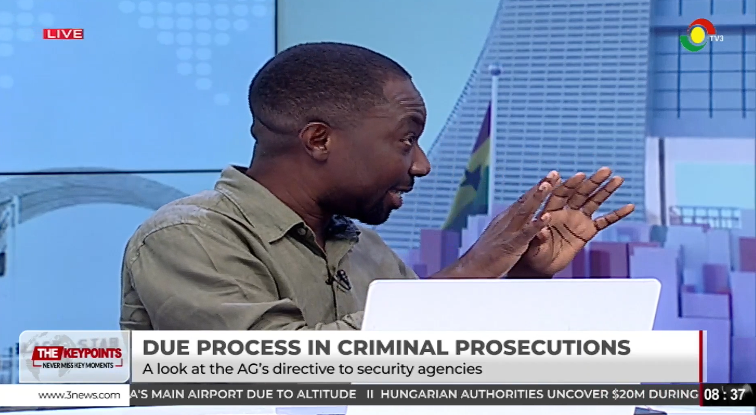
A heated discussion on TV3’s The KeyPoints has brought renewed attention to two major issues in Ghana’s public affairs: the Economic and Organised Crime Office (EOCO) investigation involving former government official Dennis Miracles Aboagye and the government's acquisition of a US$60.68 million Dassault Falcon 6X aircraft.
The Saturday, November 21, 2026, programme featured arguments over accountability, the treatment of persons under investigation and the government's decision to acquire a new aircraft amid continuing concerns about the cost of living and pressure on public services.
The discussion brought together political and legal perspectives, with Aboagye defending himself against the GH¢55 million allegations while private legal practitioner Martin Kpebu questioned the government's justification for the aircraft purchase.
Miracles Aboagye challenges GH¢55 million allegations
New Patriotic Party (NPP) Director of Communications Dennis Miracles Aboagye rejected what he described as the public's premature association of his name with an alleged GH¢55 million financial irregularity.
Aboagye, a former Executive Secretary of the Inter-Ministerial Coordinating Committee on Decentralisation (IMCCoD), said EOCO had not discussed the specific GH¢55 million figure with him during his interactions with investigators.
He said he had personally asked investigators on four occasions when they intended to discuss the amount allegedly linked to him.
According to him, the public narrative had unfairly portrayed him as responsible for the entire amount despite the investigation remaining unresolved.
The GH¢55 million figure relates to EOCO investigations into suspected financial and procurement irregularities at IMCCoD. The agency has said its inquiry followed a forensic audit covering the period between August 2022 and February 2025.
EOCO previously stated that Aboagye, former IMCCoD accountant Gerald Appiah and other individuals were under investigation over suspected misappropriation, diversion and theft of public funds.
The allegations include suspected offences such as conspiracy to steal, causing financial loss to the state and money laundering.
Aboagye has denied wrongdoing. No conviction has been established against him in the matter, and the investigation should not be treated as proof of guilt.
Martin Kpebu questions government's justification for new jet
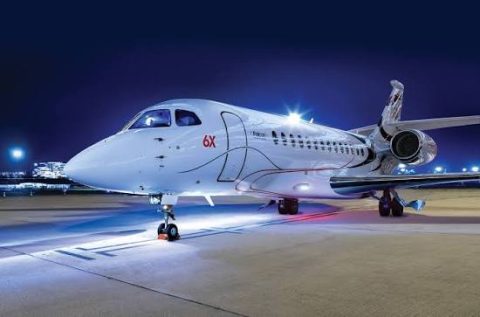
The debate also focused on the government's acquisition of a new Dassault Falcon 6X aircraft, which arrived in Ghana on November 16, 2026, at a reported cost of US$60.68 million.
Martin Kpebu criticised the government's justification for the purchase, arguing that improvements in economic indicators do not necessarily reflect the financial circumstances facing ordinary Ghanaians.
He said the government should acknowledge that its position on acquiring a new presidential aircraft had changed from the arguments made by leading NDC figures while in opposition.
Kpebu maintained that the acquisition was difficult to justify when many citizens continued to experience high living costs, unemployment and pressure on essential public services.
He called on the government to apologise rather than rely solely on improved economic indicators to defend the decision.
Former Asante Akim North MP Andy Appiah-Kubi also called on the NDC government to acknowledge the change in its position and apologise to the public.
Why the government says Ghana needed a new aircraft
The government has defended the acquisition as part of efforts to replace the ageing Falcon 900EX, which has been in service since 2010.
Government Communications Minister Felix Kwakye Ofosu previously disclosed that the older aircraft had experienced serious technical and maintenance problems.
These included corrosion in its wing fuel tanks, fuel leakages, damage to an engine component and intermittent starter-generator faults.
The aircraft reportedly spent approximately eight months in France during maintenance in 2025, with difficulties sourcing replacement parts contributing to the prolonged repair period.
The new Falcon 6X is manufactured by French aerospace company Dassault Aviation. It has a reported maximum range of approximately 10,186 kilometres, allowing longer international journeys with fewer refuelling stops.
The government says the Ghana Air Force will operate and maintain the aircraft as part of the country's broader military aviation modernisation programme.
Parliament approved the US$60.68 million procurement
The purchase agreement received parliamentary approval on December 4, 2025.
The Falcon 6X procurement was separate from another agreement valued at €125.97 million for four Airbus helicopters, comprising one H160 and three H175 aircraft.
Government representatives have argued that improved economic conditions made the acquisition affordable without additional borrowing.
However, the Minority in Parliament has questioned the government's position and demanded greater disclosure of the procurement process, financing arrangements and contract details.
The controversy has also revived memories of the NDC's criticism of the previous NPP administration's plans to acquire a new presidential aircraft.
Public accountability remains at the centre of the debate
The discussion on The KeyPoints reflects wider questions about how public funds should be prioritised and how political parties should be held accountable for positions they take while in opposition and in government.
For critics of the aircraft purchase, the central concern is whether spending US$60.68 million on a new aircraft should take priority while households, students and public institutions face financial pressures.
Supporters of the acquisition point to the maintenance difficulties of the older aircraft, the operational requirements of the Ghana Air Force and the need for reliable long-distance state transport.
Meanwhile, the EOCO investigation involving Aboagye remains a separate matter requiring evidence and due process.
The two issues have nevertheless become part of a broader national conversation about transparency, responsible public spending and accountability in Ghana's political leadership.


Comments (0)
No comments yet.
Only registered readers can comment.
Sign in or create a free account to join the discussion.