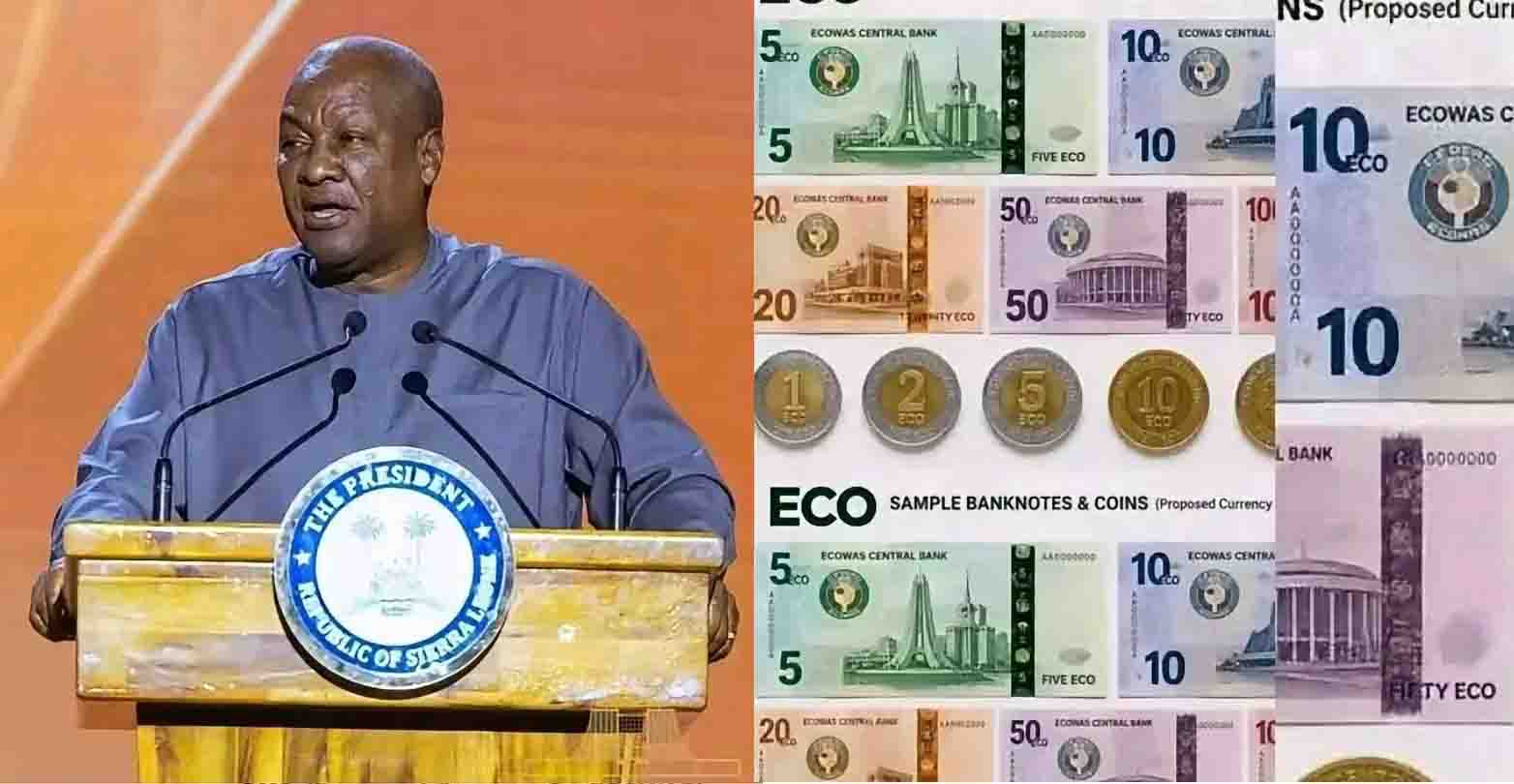
President John Dramani Mahama has renewed calls for the introduction of a common West African currency, proposing that ECOWAS countries which meet the required economic conditions should be allowed to adopt the ECO without waiting for all member states to qualify.
Speaking at the West Africa Integration and Investment Summit (WAIIS) in Freetown, Sierra Leone, Mahama said the proposed currency could initially operate alongside national currencies, allowing participating countries to settle regional trade transactions without relying on the US dollar.
The proposal, presented jointly by Mahama and Sierra Leonean President Julius Maada Bio at an earlier ECOWAS summit, is intended to overcome years of delays in the region's monetary integration programme.
Mahama questions repeated delays in ECO currency plans
Mahama said the introduction of the ECO had remained uncertain for decades because the number of countries meeting the required economic convergence criteria continued to fluctuate.
He recalled that the number of qualifying countries had changed over the years, moving from two to five, falling to three before increasing to seven and subsequently declining again.
He argued that waiting for all 15 ECOWAS member states to meet the requirements simultaneously could continue to delay the project indefinitely.
The President therefore proposed allowing countries that are ready to proceed with the currency while others work towards meeting the necessary economic benchmarks.
Under the suggested arrangement, participating countries would retain their national currencies while using the ECO to settle eligible cross-border trade transactions.
This would provide an alternative to routing regional trade payments through the US dollar and could simplify transactions between participating economies.
However, the proposal remains subject to discussions and agreement among ECOWAS member states. The ECO has not yet been introduced as a common regional currency.
Ghana wants stronger regional electricity trade
Beyond monetary integration, Mahama called for greater investment in connecting electricity grids across West Africa to improve power supply and reduce energy costs.
He proposed increasing cross-border electricity trade from approximately 7 per cent to nearly 30 per cent within five years through stronger transmission links and regional cooperation.
The President said countries with surplus electricity should be able to supply neighbouring markets rather than requiring every country to independently develop all forms of power generation.
He also disclosed that Ghana's expanding gas resources and investments in thermal generation could position the country to supply approximately 2,000 megawatts of surplus electricity to the regional market.
However, he identified inadequate transmission infrastructure as a major obstacle, warning that surplus electricity would have limited value if neighbouring countries could not receive it through connected grids.
Mahama maintained that affordable and reliable electricity was essential for industrialisation, manufacturing and economic competitiveness.
Mahama raises concern over Ghana's $3 billion food import bill
The President also highlighted Ghana's dependence on imported food products, disclosing that the country spends approximately US$3 billion annually on food imports, including rice and poultry.
He argued that Ghana and other West African countries must invest more in domestic agricultural production, food processing and storage facilities to reduce reliance on foreign suppliers.
According to Mahama, increasing agricultural output without developing processing capacity would limit the economic benefits available to farmers and local businesses.
He called for greater private-sector investment in poultry production, rice cultivation and other agricultural value chains, stressing that local industries should be supported to meet domestic demand.
The President also cited the palm oil industry as an example of the region's missed opportunities, noting that West Africa, despite being the crop's historical home, now imports significant quantities of palm oil from countries such as Malaysia and Indonesia.
He said expanding local production and processing would create employment, strengthen food security and retain more economic value within African economies.
Trade barriers continue to undermine regional integration
Mahama further called on ECOWAS governments to remove unnecessary restrictions that make it difficult for businesses to move goods across national borders.
He identified multiple checkpoints, transport difficulties, regulatory obstacles and inadequate infrastructure as major constraints on regional trade.
The President noted that trade among African countries had reportedly increased from approximately 11 per cent when the African Continental Free Trade Area (AfCFTA) agreement was signed to about 15 per cent.
However, he said the figure remained significantly below the estimated 50 to 60 per cent recorded within the European Union.
He also criticised the slow progress of major transport infrastructure projects, particularly the proposed Lagos-Abidjan corridor, which has been discussed for decades.
Mahama argued that the development of highways, railways, ports and common border facilities would improve the movement of goods and services across West Africa.
He called for the removal of unnecessary police and security barriers along trade routes, saying regional integration must translate into practical benefits for businesses and ordinary citizens.
Sierra Leone summit seeks to turn regional ambitions into investment
The West Africa Integration and Investment Summit was convened under the leadership of Sierra Leonean President Julius Maada Bio to strengthen economic cooperation and connect regional development priorities with investment opportunities.
The gathering brought together political leaders, government officials, investors, development finance institutions and private-sector representatives.
Its agenda focused on energy and industrialisation, strategic minerals, agribusiness and food systems, and digital transformation.
The summit highlighted an investment pipeline exceeding US$180 billion across these priority sectors, alongside opportunities within a regional market of more than 450 million people.
Organisers have also emphasised the importance of tracking commitments and advancing proposed projects beyond the summit through the WAIIS Secretariat.
Mahama described the initiative as an opportunity to bring governments, financial institutions and businesses together to address obstacles that have slowed economic integration across the region.
Mahama urges ECOWAS leaders to move beyond declarations
The President's proposals reflect a broader call for West African governments to move from repeated political commitments towards practical implementation.
He argued that a phased ECO currency, stronger electricity connections, increased local food production and improved transport infrastructure could help unlock the region's economic potential.
For Ghana, the proposals also present an opportunity to expand electricity exports, strengthen domestic agriculture and improve access to neighbouring markets.
However, the success of the initiatives will depend on political agreement, economic readiness, infrastructure investment and sustained cooperation among ECOWAS member states.
Mahama's message at the summit was that regional integration should not remain an aspiration but should produce measurable improvements in trade, employment, investment and living standards across West Africa.

Comments (0)
No comments yet.
Only registered readers can comment.
Sign in or create a free account to join the discussion.