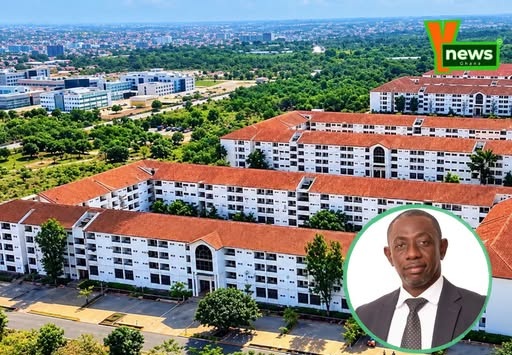
The Acting Rent Control Commissioner, Frederick Opoku, has intensified pressure on the University of Ghana Enterprises Limited (UGEL) over accommodation charges at the university's Diaspora Halls, insisting that student accommodation providers must comply with Ghana's rent regulations.
The dispute follows the University of Ghana's decision to reduce its proposed 26 per cent hostel fee increase to 15 per cent for the 2026/2027 academic year, bringing the annual charge for students in standard four-bed rooms from GH¢7,000 to GH¢8,050.
The revised amount is GH¢770 lower than the university's original proposal of GH¢8,820.
Although the reduction followed consultations with student leaders, Opoku maintains that the revised 15 per cent increase does not resolve the regulatory concerns raised by his department.
Speaking on TV3's New Day programme on Friday, November 20, he disclosed that 10 students had formally submitted complaints requesting intervention by the Rent Control Department.
He said his office was preparing to summon UGEL to appear before the department for a hearing.
Rent Commissioner Insists on Enforcement of Rent Laws
Opoku has maintained that accommodation facilities operated commercially cannot automatically be exempted from rent regulations simply because they are associated with a public university.
He argued that the relevant laws must be respected by all accommodation providers, including those operating student hostels.
The Commissioner said his department intended to invite UGEL to respond to the complaints submitted by students and explain the basis for its accommodation charges.
He warned that failure to honour a formal summons could result in proceedings being conducted without the company's participation.
The Commissioner has also insisted that UGEL should comply with a 10 per cent cap on hostel fee increases rather than maintain the revised 15 per cent adjustment.
He has called on the Ghana Tertiary Education Commission (GTEC) to ensure that the university's commercial subsidiary complies with the directive before further discussions take place.
How the University of Ghana Reduced the Proposed Increase
The controversy began after UGEL proposed increasing annual accommodation charges in the university's four Diaspora Halls from GH¢7,000 to GH¢8,820.
The proposed adjustment represented a 26 per cent increase and attracted criticism from students concerned about the growing cost of university accommodation.
Following consultations with student leadership, the University announced on November 19 that the proposed increase had been reduced to 15 per cent.
Under the revised arrangement, students occupying standard four-bed rooms will pay GH¢8,050 annually for the 2026/2027 academic year.
The University explained that the accommodation facilities were developed partly through commercial loans secured to expand residential capacity when public funding was insufficient.
It said the charges were intended to cover loan repayments, electricity, water, maintenance and other operational expenses.
Management argued that the facilities must remain financially sustainable to prevent the accumulation of unsustainable debts and possible disruption of accommodation services.
University Questions Rent Control's Legal Authority
While acknowledging the Rent Control Department's statutory responsibilities, the University of Ghana has raised questions about whether the Rent Act, 1963 (Act 220), and the Rent Control Act, 1986 (P.N.D.C.L. 138), apply to student accommodation managed by UGEL.
In a statement signed by Registrar Michael Opare Atuah, the University said the nature of the accommodation agreements between UGEL and students raised legal questions that required clarification.
Management maintained that the issue should be addressed through appropriate legal and institutional processes.
The University also indicated its willingness to engage the Rent Control Department and provide relevant financial and operational information to support discussions about a fair and sustainable accommodation fee structure.
The disagreement therefore involves not only the amount students should pay but also the legal authority responsible for regulating the charges.
Education Minister Directs GTEC to Engage Rent Control
Education Minister Haruna Iddrisu has intervened by directing GTEC to work with the Rent Control Commission to explore ways of regulating accommodation fees in tertiary institutions.
The directive followed discussions involving the minister, Acting Rent Commissioner Frederick Opoku and GTEC Director-General Professor Ahmed Jinapor.
The proposed engagement is expected to address concerns about rising hostel charges while considering the financial responsibilities of accommodation operators.
The minister has emphasised the need to balance students' welfare with the financial sustainability of university residential facilities.
However, Opoku has indicated that he wants UGEL to comply with the 10 per cent limit before he participates in further discussions.
Inspection Confrontation Adds to Tensions
The disagreement escalated following an inspection of some UGEL-managed residential facilities on Tuesday, November 17.
The Rent Control Commissioner and officials from his department visited the facilities after receiving complaints about accommodation charges and hostel conditions.
The inspection reportedly resulted in a confrontation between Rent Control officials and a UGEL staff member.
The University subsequently expressed regret over the incident, saying everyone representing the institution was expected to demonstrate professionalism, courtesy and respect during disagreements.
Management added that it would review the circumstances surrounding the confrontation and take appropriate action where necessary.
The inspection was also intended to assess complaints about sanitation, maintenance and other deficiencies in some residential facilities.
The University acknowledged students' concerns and said renovation work had started in phases, with UGEL directed to prioritise urgent repairs, sanitation and pest control.
Students' Accommodation Costs Remain Under Scrutiny
The controversy has expanded beyond the four Diaspora Halls, with student representatives warning private hostel operators against imposing excessive accommodation increases.
The University of Ghana Students' Representative Council has argued that rising housing costs are placing pressure on students and could affect their academic experience.
The disagreement has also renewed calls for clearer regulation of student accommodation fees across tertiary institutions.
For now, the GH¢8,050 annual charge represents the University's announced 15 per cent adjustment, but the Rent Control Department continues to challenge its compliance with the applicable regulatory requirements.
The outcome of the planned hearing and the engagement between GTEC and Rent Control could determine how accommodation charges are regulated at the University of Ghana and potentially other tertiary institutions across the country.






Comments (0)
No comments yet.
Only registered readers can comment.
Sign in or create a free account to join the discussion.