US President Donald Trump has threatened to impose substantial taxes or penalties on American technology companies that build artificial intelligence data centres outside the United States, arguing that the move is necessary to protect America's technological advantage over China.
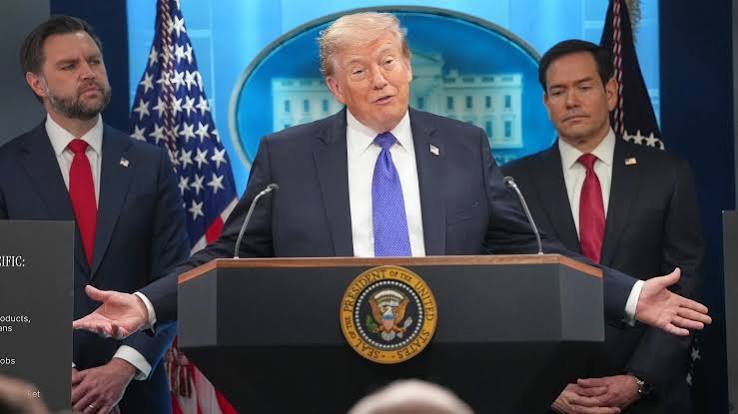
Trump made the announcement on Friday, November 20, 2026, during a White House press conference following his diplomatic trip to Asia, where he met Chinese President Xi Jinping and Russian President Vladimir Putin.
Flanked by Vice President JD Vance and Secretary of State Marco Rubio, Trump said his administration would not allow American companies to expand AI data centre construction overseas without facing significant financial consequences.
"We're not allowing data centers to go into other countries because China will take all of them, and we're not allowing that to happen," Trump said.
He added that companies attempting to build such facilities abroad would face a "tremendous tax".
The announcement signals a push to keep more of America's artificial intelligence computing infrastructure within its borders as Washington intensifies competition with Beijing over advanced technology.
Trump Wants AI Infrastructure Kept in America
Trump argued that allowing American technology companies to construct major AI data centres abroad could create opportunities for China to access computing resources that Washington considers strategically important.
Data centres are essential to the development of artificial intelligence because they house the servers, advanced processors and networking equipment required to train and operate sophisticated AI models.
The president believes keeping these facilities in the United States would strengthen domestic technological capabilities and limit opportunities for foreign competitors to benefit from American investment.
His proposed policy would target US-based companies that choose to establish AI computing infrastructure in other countries.
However, Trump did not explain whether the proposed penalties would apply to every overseas data centre or only facilities considered strategically sensitive.
Trump Has Not Explained How the Proposed Tax Would Work
Despite the strong language, important questions remain about how the proposal would become government policy.
Trump did not provide a proposed tax rate, implementation timeline or details about which government agency would enforce the measure.
The president also acknowledged that he had not yet discussed the proposal with members of his administration.
This leaves uncertainty over whether the White House intends to introduce new legislation, use existing regulatory powers or pursue another mechanism to discourage overseas construction.
The proposal could also face legal and political challenges. Congress holds constitutional authority over federal taxation, meaning the administration would need an appropriate legal basis to introduce a new tax.
For now, Trump's remarks represent a policy threat rather than an implemented restriction.
China Competition Driving Washington's AI Strategy
The announcement comes amid growing competition between the United States and China over artificial intelligence, advanced semiconductor technology and high-performance computing.
Washington has introduced restrictions on China's access to certain advanced American AI chips, citing national security concerns and the potential military applications of powerful computing systems.
The administration has also taken steps to restrict remote access to advanced US computing chips and servers.
One concern is that Chinese companies could obtain access to powerful American processors by renting computing capacity through data centres located in countries where the chips can legally be supplied.
Reuters reported that the proposed overseas penalties could affect major data centre developers, including Equinix and Digital Realty, whose businesses depend on establishing facilities in different international markets.
The companies and other technology infrastructure providers often build data centres close to customers to reduce delays, improve service reliability and comply with local data-processing requirements.
Trump Urges Communities to Welcome Data Centre Projects
While threatening penalties for overseas construction, Trump also encouraged American communities to welcome new data centre developments.
He argued that local authorities should negotiate financial benefits from technology companies seeking to establish facilities in their areas.
"You ought to take advantage of the data centers. Make them pay you, make them pay your community, but don't shut them off," he said.
His comments come as resistance to large data centre projects grows across parts of the United States.
Residents and local authorities have raised concerns about the facilities' enormous electricity requirements, water consumption, environmental effects and potential impact on household utility bills.
Technology companies, including Google and Meta, have responded to growing opposition by making commitments involving local investment, infrastructure improvements and greater transparency.
Trump maintains that communities should focus on the economic opportunities associated with the projects rather than blocking their construction.
Announcement Follows Trump-Xi-Putin Summit
The proposed restrictions were announced shortly after Trump's meetings with Xi Jinping and Vladimir Putin in China.
During the trip, Trump highlighted his discussions with the Chinese president and described their relationship as positive, while continuing to emphasise the need for the United States to maintain its technological advantage.
The White House also highlighted several domestic and foreign policy issues during Friday's press conference.
Chief of Staff Stephen Miller outlined administration priorities, including deregulation, border security and energy production.
Secretary of State Marco Rubio defended the importance of diplomatic engagement among major powers, particularly countries possessing nuclear weapons, arguing that maintaining communication channels is important for managing international risks.
However, the summit did not produce a comprehensive agreement on artificial intelligence infrastructure or a new international framework governing access to advanced computing technology.
What Trump's Proposal Could Mean for the Global AI Industry
If implemented, Trump's proposal could have significant implications for American technology companies with international expansion plans.
AI developers increasingly require data centres across different regions to serve customers, reduce latency, improve reliability and comply with national data protection laws.
A major tax penalty on overseas facilities could force companies to reconsider where they invest and how they organise their computing infrastructure.
It could also affect countries seeking to attract American technology investment and become regional hubs for artificial intelligence services.
For now, the details remain uncertain. No formal tax framework or enforcement mechanism has been announced.
The proposal nevertheless highlights how the competition between Washington and Beijing is increasingly shaping decisions about where the world's most important AI infrastructure will be built.



Comments (0)
No comments yet.
Only registered readers can comment.
Sign in or create a free account to join the discussion.