
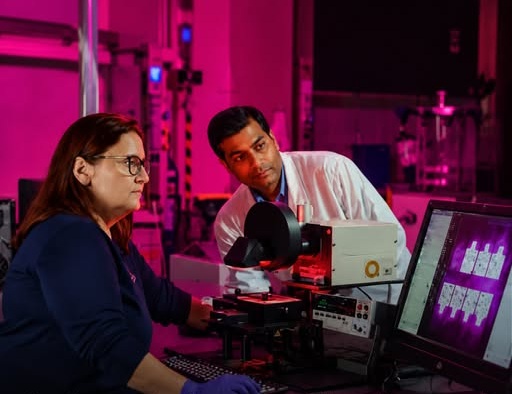
MIAMI — Imagine a sheet of material thinner than paper that soaks up sunlight to charge your devices by day, then glows at night, all from the same surface.
Engineers at Florida International University (FIU) in the United States have built just that. Their device, called SOLED, works as both a solar panel and a light-emitting diode (LED). It is thin and flexible enough to be stitched onto clothing.
The research, published in the journal Nano Energy, was developed with American soldiers in mind. But the idea of a single, lightweight material that both makes power and produces light could matter far beyond the battlefield.
One material, two jobs
SOLED is made from perovskite, a family of crystal materials that has become one of the most exciting areas of solar research because it is cheap to make and very good at handling light. The FIU team used a formamidinium lead iodide perovskite, fine-tuned with small amounts of rubidium and potassium.
The device works in two directions:
- As a solar panel: sunlight goes in and electricity comes out, at up to 22% efficiency. That is competitive with many commercial solar panels on rooftops today.
- As a light source: run the device in reverse, and electricity goes in and light comes out, at nearly 11% efficiency.
The light it gives off is near-infrared, peaking at a wavelength of 818 nanometres. That is just beyond what the human eye can see, but it is ideal for night-vision equipment, biometric scanners such as face and fingerprint readers, and medical imaging.
From the lab bench toward real use
Many promising materials work only as tiny lab samples. The FIU team has shown SOLED can be made bigger without losing much performance, scaling it up from samples just 0.1 square centimetres in size to larger devices while keeping solar efficiency above 20%.
Lead author Neetesh Kumar, an assistant research professor at FIU, said scaling is difficult because the device is built from many very thin layers, but the team has so far made steady progress.
Why soldiers need it
The research is driven by a heavy problem. A US soldier can carry up to 20 pounds (about 9 kg) of batteries on a mission to power radios, GPS units and other electronics. Recharging them in the field often means noisy, hot generators that can give away a unit's position.
SOLED offers a quieter alternative. Stitched onto a uniform or a backpack, it could recharge equipment silently from sunlight and also double as a discreet infrared light source.
Lead researcher Daniela Radu, who chairs FIU's department of mechanical and materials engineering, said the goal is to reduce soldiers' dependence on batteries, generators and resupply, increasing energy resilience at the level of the individual soldier.
The work is funded by a US$10 million grant from the US Department of War and is part of FIU's Center of Excellence for Integrated Resilient Energy and Energy Storage, with collaborators at Pennsylvania State University.
Beyond the battlefield
The same features that appeal to the military, light weight, flexibility and the ability to both generate power and give off light, could have civilian uses too. Researchers and industry have long been interested in solar materials that can be built into clothing, bags, tents and portable electronics, and SOLED's near-infrared light could be useful in security scanners and medical devices.
Could this help Africa?
For regions where millions of people still live without reliable electricity, flexible, lightweight solar materials are an exciting prospect. Wearable or roll-up solar sheets that charge phones by day could one day complement the solar lamps and home systems already common in off-grid communities across Africa, including parts of Ghana.
That day is not here yet. Perovskite technology still faces well-known hurdles before it reaches the mass market, including how long devices last outdoors in heat and humidity, and the use of lead in many perovskite recipes. SOLED is a research breakthrough, not a product you can buy.
What comes next
The FIU team plans to keep scaling the device and improving its performance, with the long-term aim of building it into soldiers' gear. If it succeeds, the technology could eventually find its way into everyday products, from smart clothing to portable chargers.









Comments (0)
No comments yet.
Only registered users can comment.
Sign in or create a free account to join the discussion.