
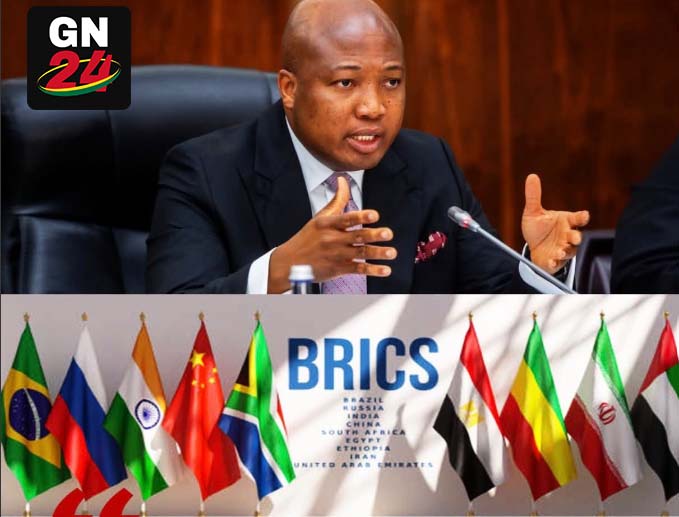
ACCRA — Ghana wants to join BRICS, and the decision has sparked a heated debate. Supporters see cheaper goods, new markets and more investment. Critics warn of possible US tariffs that could hurt Ghanaian exporters.
So what does it actually mean for traders, workers, farmers and families? Here is a plain-language guide to what is known, what is not, and what could change for you.
The decision in brief
- What happened: Foreign Affairs Minister Samuel Okudzeto Ablakwa announced last week that Cabinet has approved Ghana's application to join BRICS. He made the announcement during a visit by India's External Affairs Minister, S. Jaishankar.
- What kind of membership: Ghana will start as a partner country, not a full member, and move gradually towards full membership.
- Is it new? No. The minister says Ghana's interest predates the current government, and a Cabinet-appointed committee recommended membership back in 2023.
- The government's position: Ghana says it remains non-aligned and is acting in its national interest, aiming to be "a reliable friend to all." Ablakwa says Ghana's international partners have already been briefed.
What is BRICS?
BRICS began as a group of five big emerging economies: Brazil, Russia, India, China and South Africa. It has since grown to 11 members. Its members cooperate on trade, investment and finance, and many want to rely less on the US dollar in international trade.
Why Ghana wants in
The simplest answer is that Ghana already does much of its business with BRICS countries. Four of Ghana's five biggest export markets in 2025 were BRICS members: China, India, South Africa and the United Arab Emirates.
China alone bought about $2.67 billion worth of Ghanaian goods in 2025, according to the Chinese Ambassador. He has said Ghanaian cocoa previously faced Chinese tariffs of between 8% and 22%, and China has offered zero tariffs on Ghanaian goods without requiring Ghana to do the same in return.
Closer ties could mean easier market access, new investment and more ways to pay for trade. Ghana is already piloting a banking arrangement that lets Ghanaian businesses pay Chinese suppliers in Chinese yuan without first buying US dollars.
The US tariff threat, explained
The biggest worry is Washington. US President Donald Trump has made two separate threats against BRICS countries:
- 100% tariffs on BRICS countries that create or support a currency to replace the US dollar. He first made this threat in November 2024 and repeated it in January 2025.
- An extra 10% tariff on any country that aligns with what he called the "anti-American policies" of BRICS, announced in July 2025.
There are important details here. Neither threat automatically applies just because a country joins or seeks partnership. A US administration source told Reuters the 10% levy would depend on countries taking specific policy actions. There is also no sign so far that Washington considers Ghana's bid a trigger for either tariff.
The legal picture has also changed. In February 2026, the US Supreme Court struck down a large part of Trump's tariff programme that had been imposed under an economic emergency law.
What it could mean for your pocket
If you buy imported goods: The government has said it offered zero tariffs on fewer than 150 Chinese products. If these include machinery and raw materials, Ghanaian factories could cut costs, and some goods could become cheaper in the shops.
If you work in local manufacturing: The same move has a downside. If cheaper Chinese finished goods compete directly with what Ghana makes, local factories could struggle, putting jobs at risk. The government has not yet said which products are on the list.
If you export to the US: If a US tariff were ever applied, Ghanaian products sold in America would become more expensive there and harder to sell. That would hit exporters and the workers and farmers who supply them. For now, though, this is a risk rather than a reality.
If you trade with China, India or the UAE: You stand to gain most from smoother payments, possible tariff cuts and closer business ties.
The case for and against
Supporters argue that Ghana's trade is already heavily linked to BRICS, so a seat at the table makes economic sense. They say it gives Ghana more options for markets, investment and financing, instead of relying on any single partner.
Critics argue that the move could strain relations with the United States, an important partner for trade, aid and investment. Some, including voices in the opposition NPP, say Ghana should stay at partner level rather than seek full membership. Others want the government to explain the trade-offs more clearly before going further.
What to watch
A few questions will decide how this affects ordinary Ghanaians:
- Will the government publish its BRICS policy paper? Analysts are calling for it to set out the expected benefits, the risks and the plan to protect local industries and exporters.
- Which Chinese products get zero tariffs? The list will show who gains and who faces new competition.
- How will Washington respond? Any official US reaction to Ghana's partner bid will be a key signal.
- When will Ghana become a partner? The timeline depends on BRICS members accepting the application.

Comments (0)
No comments yet.
Only registered users can comment.
Sign in or create a free account to join the discussion.