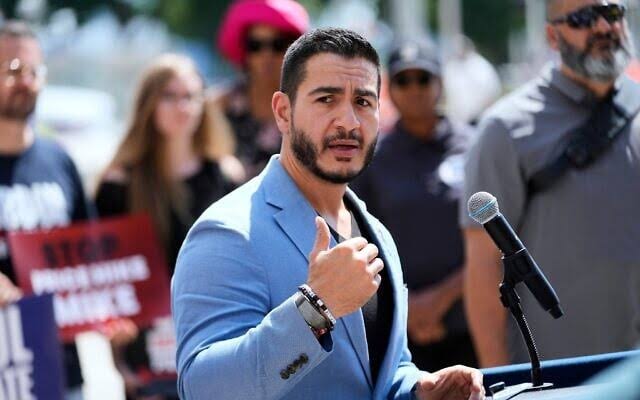
Michigan Senator-elect Abdul El-Sayed has reignited debate over Israel’s national identity after declaring that he opposes ethnostates and believes governments should guarantee equal rights to all citizens, regardless of religion or ethnicity.
El-Sayed made the comments during an appearance on NBC’s Meet the Press on Sunday, November 22, 2026, where he was interviewed by host Kristen Welker about his position on Israel, the conflict involving Iran and his priorities ahead of joining the United States Senate.
The Democratic politician maintained that his opposition to ethnostates was a general principle and not an argument directed exclusively at Israel.
“I don’t believe in ethno-states,” El-Sayed told Welker, adding that he supported equal rights to peace, dignity and self-determination.
El-Sayed Says Democracy Should Take Priority Over Religious Identity
During the interview, Welker asked El-Sayed whether his position meant Israel should stop defining itself as a Jewish state, given that the country was established in 1948 with a Jewish national identity.
El-Sayed argued that Israel should uphold equal rights for all its citizens without identifying the state exclusively with a particular religion or culture.
He compared his position with the principles underpinning American democracy, saying people should enjoy equal protection under the law regardless of their religious beliefs or ethnic backgrounds.
He also referred to the political situation in Israel, arguing that Arab political representation should not be excluded from government formation.
Welker challenged his position by pointing out that 43 countries identify with a particular religion or have a constitutionally established religious identity. She cited Pakistan as an Islamic republic and Denmark as a country with a constitutionally Christian identity.
Asked why Israel, described as the world's only Jewish state, should abandon its national identity, El-Sayed responded that he opposed ethnostates generally and questioned whether the United States should fund the military of Pakistan either.
He said his position was based on applying the same principles consistently.
Senator-Elect Emphasises Palestinian and Jewish Rights
El-Sayed also argued that Palestinians should enjoy the same rights to dignity, security and self-determination as Jewish Israelis.
He pointed to Palestinian families with generations of connections to the region, saying many had been promised statehood but continued to face uncertainty as Israel expanded its control over territory.
He maintained that his argument was not opposition to Jewish people or any particular religious community, but a call for equal rights and democratic principles.
His remarks are likely to remain part of the wider American political debate over US support for Israel, Palestinian statehood and the future of the Israeli-Palestinian conflict.
Iran Policy and Potential Government Shutdown
Beyond the discussion about Israel, Welker questioned El-Sayed about whether he would support Democratic efforts to withhold government funding in an attempt to stop President Donald Trump's military policy towards Iran.
El-Sayed opposed the suggestion that Democrats would be responsible for a shutdown, arguing that the President would bear responsibility if he prioritised the war over keeping government operations running.
He described the military campaign as illegal and unjustified, arguing that Congress has constitutional authority over decisions to declare and fund wars.
However, he clarified that he did not want the federal government to shut down. Instead, he said Congress should exercise its constitutional responsibilities and challenge the administration's approach to the conflict.
El-Sayed Open to Working with Trump Administration
The Michigan senator-elect also indicated that he was willing to engage with President Trump and other members of the incoming administration where cooperation could benefit the American public.
He said he was open to discussions with both Democrats and Republicans, particularly on issues including healthcare coverage, affordability and campaign finance reform.
El-Sayed identified three priorities behind his Senate campaign: reducing the influence of money in politics, improving Americans' financial circumstances and achieving universal healthcare coverage.
He defended his support for Medicare for All while explaining that he did not necessarily want to eliminate private health insurance.
According to El-Sayed, the central objective was to guarantee basic public health insurance for every American, regardless of employment or financial circumstances.
El-Sayed Prepares to Enter the US Senate
El-Sayed's appearance comes after his election victory in Michigan, where he is preparing to take up a seat in the United States Senate.
During the interview, he also expressed support for Senator Chris Van Hollen in the contest over Democratic Senate leadership, arguing that the party needed a new approach to address economic challenges and deliver on campaign promises.
His comments on Israel, Iran and healthcare offered an indication of the issues he intends to prioritise as he prepares to take office.
The interview has placed his position on Israel's Jewish national identity at the centre of renewed debate, particularly over how the United States should balance its relationship with Israel, support for Palestinian rights and its stated commitment to democratic principles.




Comments (0)
No comments yet.
Only registered readers can comment.
Sign in or create a free account to join the discussion.