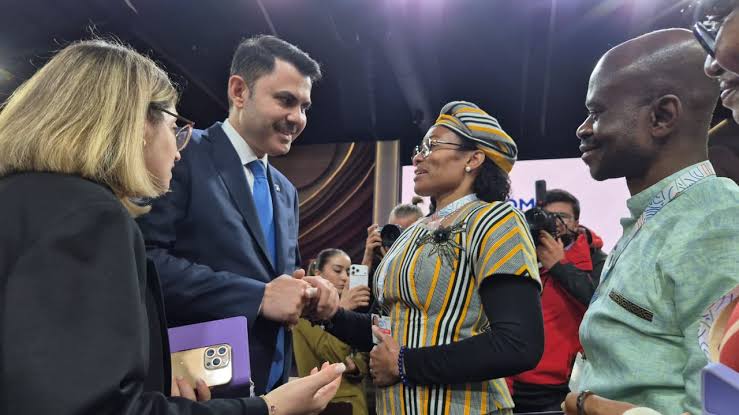
Ghana’s Minister for Environment, Science and Technology, Dr Zanetor Agyeman-Rawlings, has protested what she described as disrespectful treatment after being interrupted while presenting Africa’s collective position at the closing plenary of the 31st United Nations Climate Change Conference (COP31) in Antalya, Türkiye.
The incident triggered objections from the Ghanaian delegation and an apology from COP31 President Murat Kurum, who acknowledged the concerns and assured the minister that no disrespect towards Ghana or the African Group of Negotiators (AGN) was intended.
Dr Agyeman-Rawlings was speaking on behalf of the African Group, which Ghana currently chairs, when the interruption occurred during discussions on the conference’s final climate decisions.
Ghanaian Delegation Raises Formal Objection
The interruption prompted the Chair of the African Group of Negotiators, Nana Dr Antwi-Boasiako Amoah, to intervene and draw the COP31 President’s attention to the conference’s Code of Conduct.
Dr Agyeman-Rawlings also expressed her disappointment, pointing out that another delegation had been allowed to deliver its intervention without interruption while she was cut off during her presentation.
She described the incident as an example of the treatment African representatives had experienced during the negotiations and called for fairness, transparency and respect in international climate discussions.
The minister subsequently returned to the floor and completed her statement after the intervention by the African Group’s leadership.
COP31 President Murat Kurum later apologised to the Ghanaian delegation and the wider African negotiating bloc, explaining that he had not intended to target or disrespect the minister.
His apology was received with applause from delegates.
Zanetor Expresses Disappointment Over COP31 Outcomes
Beyond the interruption, Dr Agyeman-Rawlings used her address to communicate Africa’s dissatisfaction with the outcomes of the climate negotiations.
She said the continent had entered COP31 seeking ambitious decisions that would address its growing climate challenges and deliver on commitments made by developed countries.
A major concern was the lack of meaningful progress on adaptation finance and the Global Goal on Adaptation, which seeks to strengthen countries’ ability to prepare for and respond to climate change.
The minister stressed that climate ambitions could not be sustained through promises alone, arguing that vulnerable countries needed predictable financial support to implement adaptation measures.
She also raised concerns over the postponement of decisions on important issues, including the just transition mechanism, warning that inadequate financing would leave future generations facing a heavier climate burden.
Africa Demands Fair Representation in Global Climate Talks
The incident has drawn attention to wider concerns about the participation and representation of African countries in international climate negotiations.
Although African nations contribute a relatively small share of global greenhouse gas emissions, many face significant exposure to droughts, floods, rising temperatures, food insecurity and other climate-related challenges.
The African Group of Negotiators represents the collective interests of African countries in the United Nations climate process, particularly on climate finance, adaptation, technology transfer and loss and damage.
Ghana’s current leadership of the group places the country at the centre of efforts to advance the continent’s negotiating priorities.
Dr Agyeman-Rawlings’ intervention reinforced the importance of ensuring that every delegation has a fair opportunity to present its position, particularly when decisions have far-reaching consequences for vulnerable populations.
COP31 Ends Amid Disagreements Over Climate Action
The diplomatic incident came as COP31 concluded after prolonged negotiations in Antalya, with countries failing to reach agreement on an overarching political decision.
Disagreements over fossil fuels, climate finance and support for developing countries remained among the major obstacles to consensus.
The UN climate chief, Simon Stiell, acknowledged the disappointment surrounding the outcome, saying the conference had failed to agree on key presidency-led decisions. He also called for greater transparency, inclusion and improvements to the negotiation process.
For Ghana and other African countries, the conclusion of COP31 leaves important questions about how existing climate finance commitments will be translated into practical support for communities already experiencing the effects of climate change.
The episode involving Dr Agyeman-Rawlings has therefore become part of a wider discussion about Africa’s voice, representation and influence in global climate decision-making.
Comments (0)
No comments yet.
Only registered readers can comment.
Sign in or create a free account to join the discussion.