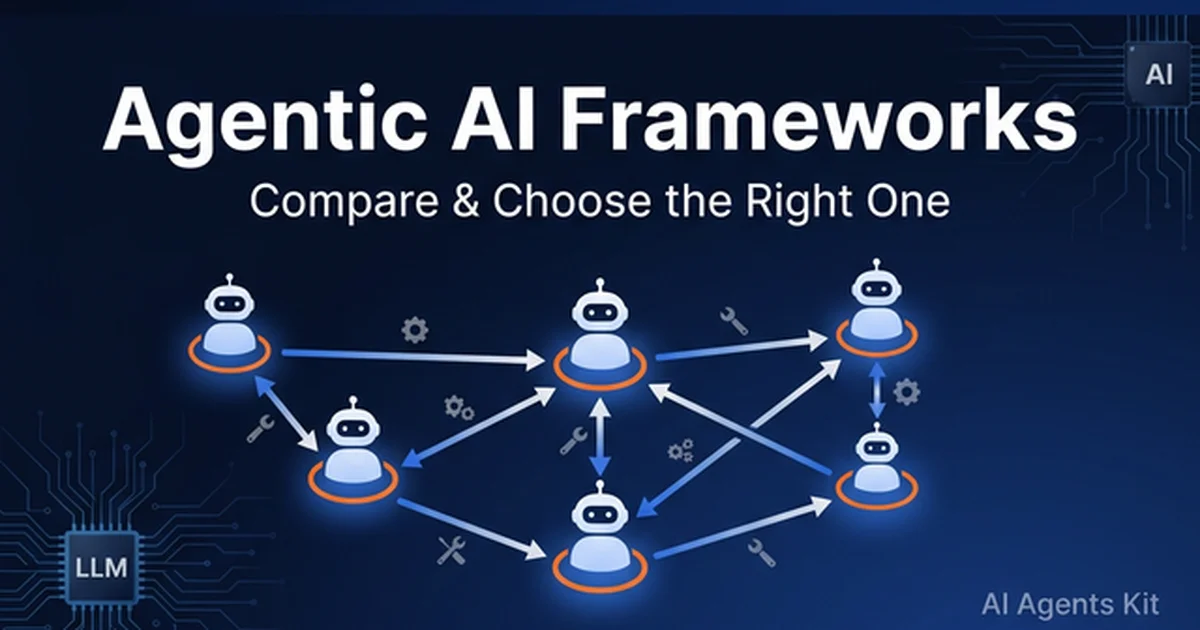
Artificial intelligence development is entering a new phase as major technology companies invest in tools that allow developers to build more reliable, coordinated and task-oriented AI agents.
Anthropic, OpenAI, Google and Microsoft are among the companies advancing developer frameworks designed to move AI beyond simple prompt-and-response interactions. These tools provide infrastructure for agents to plan tasks, use external tools, collaborate with other agents, evaluate results and repeat work when necessary.
The growing focus is on solving a persistent weakness in autonomous AI systems: a model can confidently report that it has completed a task even when the result is incomplete, inaccurate or technically broken.
Rather than relying entirely on one agent, developers can now design systems in which multiple specialised agents work together, with separate responsibilities for planning, execution, testing and evaluation.
From Single AI Agents to Coordinated Teams
Traditional AI assistants generally receive an instruction, generate an answer and stop. Although effective for many everyday tasks, this approach can struggle with complicated projects requiring several stages of work.
For example, building a software application may involve understanding requirements, designing an architecture, writing code, identifying errors, running tests and correcting problems.
A single agent may complete some of these stages successfully but overlook important requirements or incorrectly conclude that the application is ready.
Multi-agent systems introduce a more structured approach.
A developer can assign different responsibilities to specialised agents:
Planner agent: Breaks a complex request into smaller tasks and establishes an execution plan.
Builder agent: Writes code or produces the requested output.
Evaluator agent: Reviews the work against the original requirements and identifies weaknesses.
Testing agent: Runs tests and checks whether the result performs as expected.
If the evaluator or testing agent identifies a problem, the system can send the work back for corrections before approving the final result.
This creates a continuous feedback loop rather than a one-time generation process.
Major Technology Companies Developing Agent Frameworks
Several leading AI companies have introduced frameworks that give developers greater control over how autonomous systems operate.
Anthropic: Claude Agent SDK
Anthropic's Claude Agent SDK allows developers to build applications using the agent capabilities associated with Claude Code.
The framework provides access to agent execution loops, tools, permissions, hooks and support for specialised subagents. Developers can use it to create systems that interact with files, execute commands and perform complex tasks within controlled environments.
Its approach is particularly relevant to developers building coding assistants and other applications that require agents to work across multiple stages of a project.
OpenAI: Agents SDK
OpenAI's Agents SDK provides a framework for building individual AI agents and coordinating networks of specialised agents.
Its capabilities include agent handoffs, tool integration, guardrails, session management and execution tracing.
Developers can assign tasks to specialist agents while maintaining control over how information and responsibilities move between them.
The SDK also supports monitoring and debugging, allowing developers to inspect agent activities and understand how a system reached a particular result.
Google: Agent Development Kit (ADK)
Google's Agent Development Kit is an open-source framework for developing, evaluating and deploying AI agents.
It supports multi-agent architectures, allowing developers to create systems in which specialised agents collaborate or delegate tasks.
ADK also provides workflow orchestration, integrations with external tools and evaluation capabilities. It is available across several programming languages, including Python, TypeScript, Go and Java.
The framework is designed to support projects ranging from relatively simple assistants to complex business workflows.
Microsoft: Agent Framework
Microsoft's open-source Agent Framework provides tools for building and coordinating AI agents and multi-agent workflows using Python and .NET.
It supports graph-based workflows, sequential and concurrent execution, agent handoffs, human approval processes and monitoring.
The framework also includes harness capabilities for long-running tasks, helping agents manage plans, memory, files and execution approvals.
These features are intended to make agent-based applications easier to develop, test and operate in production environments.
Why Agent Harnesses and Feedback Loops Matter
One of the most important developments in this area is the growing emphasis on agent harnesses.
An agent harness is the supporting infrastructure that manages how an AI agent performs work. It can include task planning, tool access, file management, memory, execution permissions, progress tracking and error recovery.
Without these supporting systems, an AI model may struggle to manage complicated assignments over extended periods.
Feedback loops add another layer of reliability. Instead of accepting an agent's first response, the system evaluates the result, identifies problems and directs the agent to improve its work.
For software development, this could mean requiring an application to pass specific tests before the system considers the assignment complete.
This approach does not eliminate AI errors, but it creates additional opportunities to identify and correct them.
Applications Beyond Software Development
Although coding is an important use case, multi-agent systems have applications across several industries.
Businesses could use coordinated agents for customer support, financial analysis, research, document processing, data management and operational planning.
For example, a research system could assign one agent to gather information, another to verify important claims and a third to prepare a final report.
Similarly, an e-commerce company could use separate agents to analyse customer requests, check inventory, process approved transactions and monitor service quality.
The broader objective is to build AI systems capable of completing entire workflows rather than responding to isolated instructions.
Costs and Reliability Remain Major Challenges
Despite the progress, building sophisticated agent systems comes with significant challenges.
Every additional agent, model call and evaluation cycle can increase computational costs and processing time. Systems that repeatedly review and revise their work may become expensive, particularly when handling large projects.
Developers must also determine how agents share information, avoid conflicting instructions and maintain accurate records of their activities.
Security is another important consideration. Agents with access to files, external services or payment systems require carefully designed permissions and human approval mechanisms for sensitive actions.
More agents do not automatically produce better results. Poorly designed systems can introduce unnecessary complexity, duplicate work and create additional opportunities for errors.
Consequently, developers must balance autonomy with testing, monitoring, cost management and human oversight.
A New Direction for AI Software Development
The growing availability of agent development frameworks signals a shift in how AI applications are being engineered.
The emphasis is moving beyond writing increasingly detailed prompts towards designing complete systems that combine AI models, software tools, workflows, evaluation mechanisms and safeguards.
For developers, this means that building a useful AI product increasingly involves more than selecting a powerful language model. The surrounding architecture determines how reliably that model can perform real-world tasks.
As these frameworks continue to mature, coordinated AI agents could become an increasingly important foundation for software development, business automation and other complex digital services.





Comments (0)
No comments yet.
Only registered readers can comment.
Sign in or create a free account to join the discussion.