
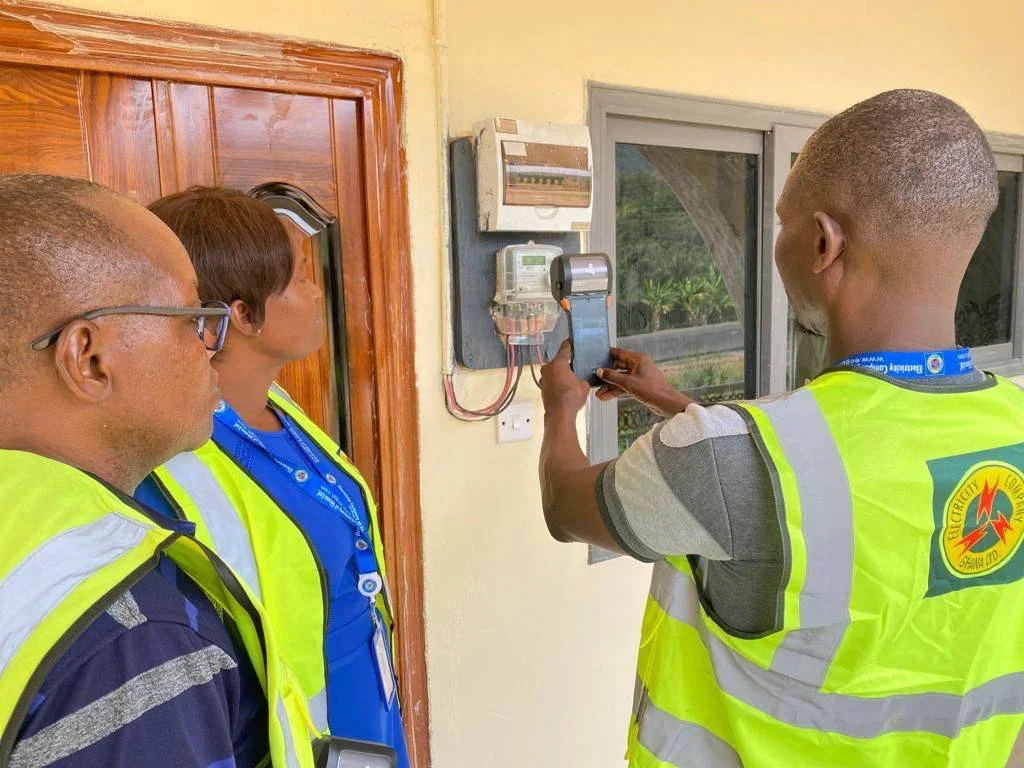
ACCRA — Electricity Company of Ghana (ECG) officials will soon be knocking on doors across the country, and this time, you may not get a letter first.
ECG has announced a Nationwide Meter Audit Exercise covering all its operational areas, aimed at reducing commercial losses, improving revenue collection and fighting electricity theft. The company made the announcement on Tuesday, October 20, 2026.
The exercise will involve inspecting and verifying:
- all prepaid and postpaid meters
- Special Load Tariff (SLT) installations used by large commercial and industrial customers
- the wiring connected to meters
ECG says the goal is to confirm that its metering systems are intact and that every customer is billed accurately for the electricity they use. A start date has not yet been announced.
No letters, no appointments
The most important detail for customers is this: ECG says its public announcement is the official notice. There will be no further notices, appointment letters or advance warnings before officials arrive.
The company has told customers, landlords, estate managers, property managers, facility managers and security guards that not having received a letter is not a valid reason to refuse, restrict or delay access to authorised ECG staff.
ECG pointed to Regulation 4(h) of the Public Utilities Regulatory Commission (Customer Service) Regulations, 2020 (L.I. 2413), which requires customers to give a utility's staff or agents safe and reasonable access to their premises to read meters or check equipment.
Why ECG is cracking down
Power theft takes many forms, including:
- bypassing the meter so some electricity is not recorded
- tampering with meters to make them run slowly
- illegal connections made directly to ECG's lines without a meter
- using fake or unregistered meters
Every unit of stolen electricity is a loss to ECG. That loss weakens the company's finances, makes it harder to maintain the network and adds to the energy-sector debts that have long weighed on Ghana's public finances, an issue the IMF mission now in Accra is examining.
A recent regional crackdown shows the scale of the problem. In 2025, ECG's Ashanti West region inspected 8,182 customers and found illegal connections at 2,248 of them. Those customers were surcharged a total of GH¢5.8 million, of which GH¢4.39 million had been recovered. A nationwide audit could uncover far more.
Beware of fake ECG staff
An audit with no advance letters creates an opening for criminals pretending to be ECG workers. ECG is urging customers to check the identity of anyone who arrives before letting them in.
How to verify an ECG worker:
- Ask to see the worker's ECG identification and their six-digit code.
- Dial *226# on your phone.
- Select Option 5.
- Enter the worker's six-digit code.
- Check that the name, region and district shown match the person in front of you.
You can also confirm by calling ECG's customer service line on 0302 611 611.
What customers should do
- Allow verified ECG staff in. Refusing access to authorised officials can put you in breach of PURC regulations.
- Never pay cash to anyone on the spot. If you are unsure about any charge, contact your local ECG office directly.
- Know what's on your property. Landlords and tenants should know where their meters are and who installed their wiring.
- Regularise any irregular connection now. Customers caught with illegal connections can be surcharged for the unbilled electricity and may face prosecution.
- Report power theft. If you suspect a neighbour or business is stealing power, report it to ECG.
What to watch
ECG has not yet said when the audit will start, which areas will be covered first, or what penalties will apply to cases uncovered. The success of the exercise will depend on fair enforcement, accurate findings and protecting honest customers from fraudsters posing as ECG staff.




Comments (0)
No comments yet.
Only registered users can comment.
Sign in or create a free account to join the discussion.